
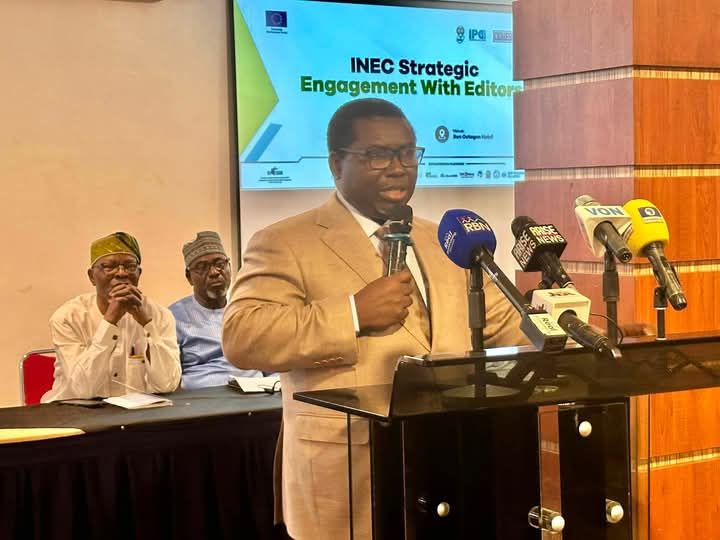
The Independent National Electoral Commission (INEC) has disclosed that Nigeria’s National Register of Voters has risen to more than 103 million ahead of the 2027 general elections. INEC Chairman, Prof. Joash Amupitan, SAN, made the disclosure on Monday in Abuja at a strategic workshop organised in collaboration with Development Alternatives Incorporated (DAI) and the Nigerian Guild of Editors (NGE).

The workshop, held at BON Hotel Octagon, Jahi District, Abuja, with the theme, “Strengthening Democracy Through Partnership Among Editors, Civil Society and Electoral Institutions,” focused on improving collaboration among INEC, the media and civil society ahead of the elections. Amupitan said the Commission’s three-phase Continuous Voter Registration exercise attracted more than 10.6 million new applicants, while the display of the Preliminary Register for claims and objections had been completed.
The INEC Chairman also announced that nationwide collection of Permanent Voter Cards (PVCs) will commence on Friday, October 9, 2026. He said the Commission had completed the final Automated Biometric Identification System (ABIS) cleanup of the voter register and urged eligible citizens to participate actively in the PVC collection exercise ahead of the 2027 polls.
Amupitan said INEC remained committed to improving the Bimodal Voter Accreditation System (BVAS) and the INEC Result Viewing Portal (IReV), stressing that public trust remained critical to the credibility of elections. He called for stronger collaboration with editors and civil society organisations, promising timely access to information and direct channels for verifying field incidents, logistics and security developments.
The INEC Chairman further urged newsrooms to establish digital fact-verification desks to combat misinformation and disinformation. President of the Nigerian Guild of Editors, Eze Anaba, also called on editors to uphold accuracy, fairness, balance and public interest in electoral reporting, while urging INEC to ensure that credible information is made readily available to the media.
Other speakers, including DAI Team Leader Rudolf Elbling, CEMESO Executive Director Dr Akin Akingbulu and International Press Centre Executive Director Lanre Arogundade, identified misinformation, election technology, media ethics, security and public trust as key issues ahead of 2027. Akingbulu urged journalists to verify information before publication, while Arogundade warned that political and economic interests could influence the ability of newsrooms to report elections impartially.
INEC National Commissioner Mohammed Haruna said the Commission had continued to improve its electoral processes through various elections and had monitored the primaries of 22 political parties ahead of 2027. Chief Press Secretary to the INEC Chairman, Adedayo Oketola, said the workshop was designed to rebuild institutional trust, strengthen fact-checking and promote shared responsibility among INEC, the media and civil society in delivering credible, peaceful and transparent elections.