
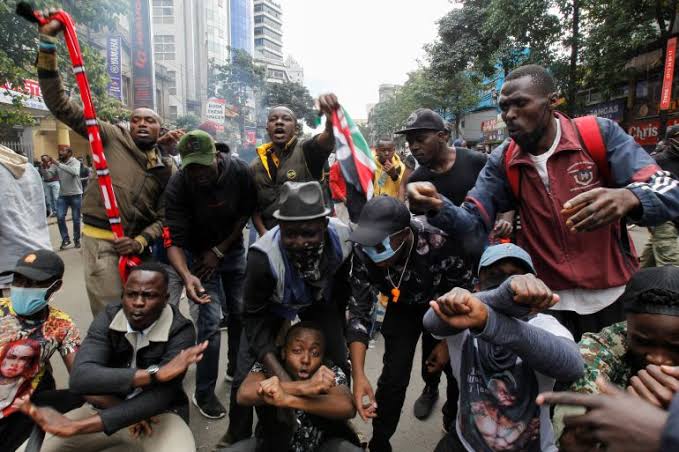

The recent uprising in Kenya, East Africa is a popular to what portends most African nations, going by what majority of the Presidents in the continent brand as democratic practices. For those who are conversant with regional politics, it can be agreed that Kenya was a force to reckon with in the East African sub-region and that during the struggle for the liberation of Africa from European colonialism, this country swimming in crisis now was a formidable Frontline state. The likes of Jomo Kenyatta and some others as Primary voices that fought European colonialism in the African continent cannot be under- rated.
While many scholars condemn the colonisation of Africa by the white in the balkanized black African continent, it is generally agreed that these people provided, to some extent basic necessities of life for our people. This is not saying that their massive exploitation of our massive mineral resources is justifiable . For instance, the provided food on our tables, facilities for education, especially at the basic level were provided and through their accompanying missionaries, some basic health centres were also erected. These are some of the facilities Jomo Kenyatta inherited as the neo- colonial President of the emancipated Kenya.
Ordinarily one should expect that the new colonial leaders in Africa were groomed by institution managed by Europeans. Furthermore, almost all of them worked under the supervision of white men as managers and supervisors. It is no gain saying that these neo- colonial leaders in Africa, including President Jomo Kenyatta of Kenya, to some extent tried to maintain the tradition of the colonial masters. Food, the greatest need for sustainance of life was non- existence as most African nations were not begging Europe, America or Asia to export basic food items to them. Here in Nigeria for instance, we had a lot of yams, cocoyam, cassava, palm oil, cocoa, groundnuts to feed our local population. Even when some of these products are exported abroad, the revenue generated from such sales are used to import by-products of these commodities for our local consumption invariably, I may say that life for most African nations did not go soar in the hands of the so called neo- colonialist who were brothers and sisters from Africa.
While these group of African leaders were working assiduously to see how African nations can develop and escape from a tag of being addressed as Third world nations, a group of radicals sponsored by self-seeking governments from the socialist block of World politics emerged. These people penetrated the rank and file, especially the military. With this, they pulled down many governments in Africa under the guise of installing democratic governments.
Kenya is no exception to this ugly trend. When President William Ruto joined the race for governing Kenya, many Kenyans loved him because he is fairly young. Furthermore he is vibrant in speech and can stand for hours on the podium elaborating on political issues, especially as they affect his country,Kenya. He made far- reaching promises on how to turn- around the numerous economic woes tormenting Kenya. He assured better economic reforms that would make lives better for Kenya people.
Unfortunately on ascension to power, President Ruto got lost on his promises to make life better to his highly impoverished population. Rather he embarked on tighter economic measures like increased tax payments, increased electricity tariffs and many others. These ignited massive wild protest in Kenya especially the youths who marched on the streets for days. These youths and others were not against President Ruto rather they were asking for economic measures that will not stifle their people to massive deaths. It is reassuring that the Kenyan President has listened and promised as second look at his policies.
This should serve as a lesson to Nigeria, the self- acclaimed giant of Africa where basic food like Garri and rice are no more accessible for the average man, cost of transportation is harsh, electricity tariff rises every day, health needs are no longer accessible to the poor man and many more. Something should be done in Nigeria to avoid the Kenyan experience.