
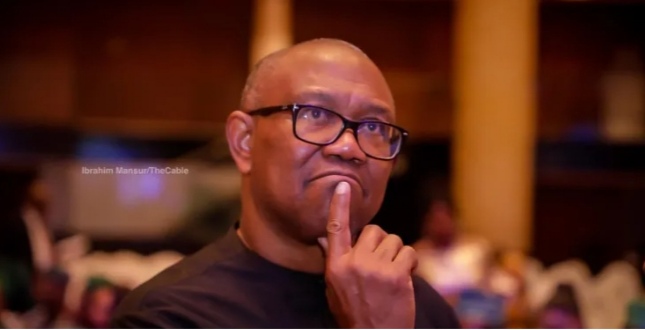
Peter Obi, has argued that he is ready to run for a single tenure as President of Nigeria, stressing that within the years in power he is optimistic of transforming the country.
According to the 2023 Labour Party Presidential Candidate;
“I still find it baffling that my decision to do a term of four years, if given the mandate to rule this country, is generating so much agitation. By this feeling, we are doubting the fact that a sincere leader can achieve much in 48 months”, Obi said.
The Labour Party stalwart dismissed suggestions that his stance was borne out of desperation or lack of ambition, emphasising that his motivation has always been service, not power.
“I have never been desperate in the pursuit of power, or anything else, for that matter,” he said.
“There are some traits associated with desperation, which in no way are in any of my political behaviours in the past and now—like engaging in overly aggressive rhetoric or actions to prove a point, becoming overly defensive to criticism, making unrealistic promises, or resorting to personal attacks against opponents.”
Obi challenged critics to scrutinise his political record, stating that he has never been associated with electoral malpractice.
“Throughout my political journey, I have never been involved in thuggery, the snatching of ballot boxes, or any form of electoral malpractice. I challenge anyone: conduct your investigations. You will find no stains of rigging or violence associated with my name. I have always chosen the path of peace, principle, and civility” he said.
He also pointed to his past contests as evidence of his commitment to fairness, saying, “Ask those who have contested against me—none were ever denied their rights, framed, or falsely accused. None was asked to place their advert materials or break the bank to do so. I believe in fair competition, not manufactured victories.”
Obi argued that with disciplined leadership, Nigeria could redirect wasteful spending into critical sectors within four years.
“In four years, we can confront corruption head-on, redirecting resources to priority areas,” he said. “For instance, the trillions used to acquire new presidential jets and other unnecessary expenses at this time could have been channelled into education, healthcare, or infrastructure.”
He added that within the same period, his administration would ensure the rule of law is sacrosanct and that elections are free and fair.
“Leadership, to me, is not about entitlement. It is about service,” Obi said. “If given the mandate, for just one term, I will dedicate every moment to building a Nigeria that works for all.”
His remarks come amid ongoing debates about governance efficiency in Nigeria, with many critics arguing that systemic corruption and poor policy implementation have hindered development despite decades of leadership changes.
Obi’s insistence on a single-term focus has drawn mixed reactions, with some praising his commitment to accountability while others saying it is borne out of desperation, questioning whether four years is enough to address Nigeria’s deep-rooted challenges.
Obi, however, remains optimistic, maintaining that with the right priorities, Nigeria’s decline can be reversed in a short time.
“What drives me is not personal ambition, but a deep commitment to see Nigeria work,” he said. “And if the sacrifice required of me is four years of sincere, accountable leadership, so be it.”
As the 2027 elections draw nearer, Obi’s message continues to resonate with a segment of the electorate disillusioned with prolonged political tenures that yield little change. Whether his proposition gains wider acceptance remains to be seen, but his insistence on term limits and efficiency has undoubtedly stirred a fresh conversation about Nigeria’s leadership future.
